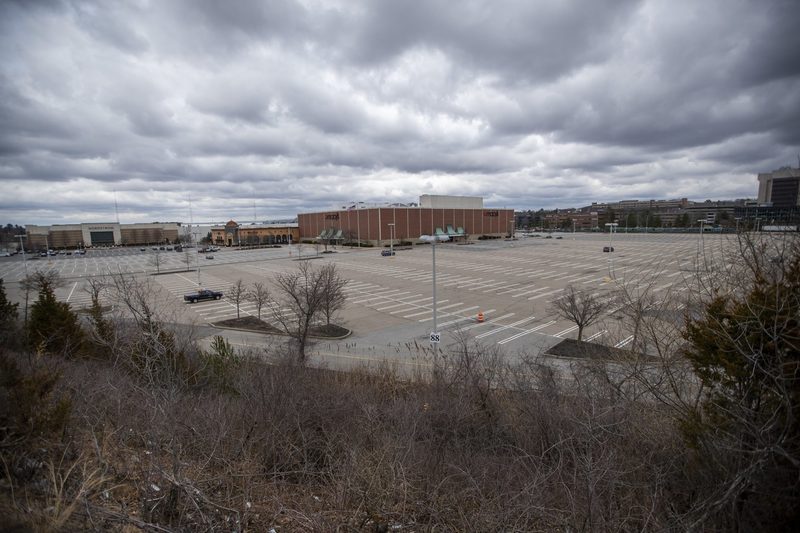
Last Thursday, after participating in the weekly nonviolent protest outside the Burlington, Massachusetts, ICE headquarters, I returned to my car parked at the Burlington Mall. The parking lot was practically empty. I had been gone about an hour. Yet before I could leave, a mall security officer stopped me and informed me that if I left the mall, my car would have to go with me.
I was taken aback. Like many people who use large shopping centers, I assumed it was a matter of common courtesy—and common sense—that a mostly vacant lot could accommodate a parked car for a short time. I told the officer as much. I also explained that I had not seen any signs or posted warnings indicating that parking was prohibited for people attending nearby activities. His response was curt and revealing: It was mall policy.
That phrase—“mall policy”—should give all of us pause.
There were no other nearby places to park. None. For anyone wishing to exercise their right to peacefully assemble and protest at the ICE facility, the practical effect was clear: either don’t come, or risk confrontation, towing, or worse. In that context, it is hard to avoid the conclusion that ICE has been in touch with the mall’s security service to ensure that demonstrators are denied even the most basic logistical support—like a place to leave a car.
This may sound trivial. After all, it’s just parking, right? But history teaches us that the erosion of constitutional rights rarely begins with dramatic, headline-grabbing acts. More often, it starts with small, bureaucratic obstacles: a rule here, a “policy” there, each one plausibly deniable, each one shifting the burden onto citizens who are simply trying to make their voices heard.
The First Amendment guarantees the right to peaceably assemble and to petition the government for redress of grievances. That right is not limited to tidy, pre-approved spaces or to protests that inconvenience no one. Nor does it evaporate when a government agency chooses to situate itself near private property that effectively controls access to the public square.
I want to be clear about what this was—and what it was not. This was not a disruptive demonstration. It was nonviolent, orderly, and weekly, the kind of civic engagement we often praise in theory. No shoppers were impeded. No traffic was blocked. The parking lot, by any reasonable standard, had room to spare. And yet a rule was enforced in a way that functioned less as property management and more as protest deterrence.
Private property owners do, of course, have rights. Malls are not town greens. But when large commercial spaces operate as de facto public commons—especially when they abut government facilities—their policies can have real consequences for public life. When those policies are selectively enforced, or enforced in coordination with government agencies, they raise serious constitutional questions.
At minimum, the public deserves transparency. If the Burlington Mall has a strict policy barring any non-shopping parking, it should be clearly posted. If that policy is being applied specifically to demonstrators, the mall and its security contractor should be willing to say so openly. And if a federal agency is leaning on private security to make lawful protest more difficult, that should concern anyone who values free expression, regardless of where they stand on immigration policy.
The right to protest does not belong to one political camp. It belongs to all of us. Today it may be immigration activists being squeezed out by “mall policy.” Tomorrow it could be labor organizers, environmental advocates, or parents speaking out at a school board.
A nearly empty parking lot should not become a tool of quiet suppression. If we allow access, convenience, and courtesy to be withdrawn whenever speech becomes uncomfortable, we will wake up one day to find that our rights have not been taken from us in a single stroke—but have simply been parked out of reach.
 Robert Gamer: Author & Activist
Leave a comment